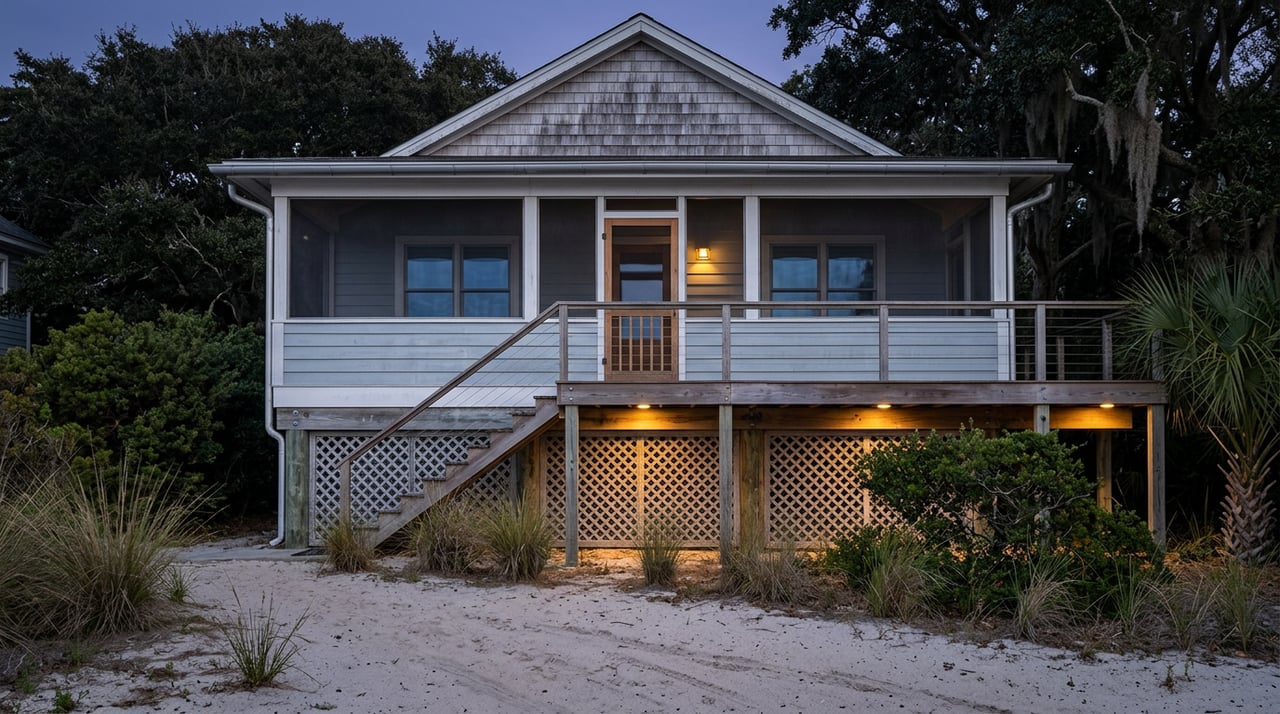
Bald Head Island's August Sea Turtle Hatch Season Guide
August 6, 2026
August 6, 2026
By late August, most of our summer neighbors have started asking the same question at the ferry terminal: is turtle season winding down? The short answer is no. The longer answer is more interesting, and it matters for anyone who owns a house here.
August is the crossover. It is the one month when late-nesting mothers are still coming ashore after dark and the earliest nests of the season are boiling out of the sand. The Conservancy's own timeline puts nesting mothers on the beach from May through August, with hatchlings emerging from July through October to begin their journey to the ocean. For roughly four weeks, both ends of the life cycle overlap on the same fifteen miles of shoreline.
An average year at Bald Head means roughly 95 nests laid and about 7,000 hatchlings produced. That is the baseline residents should hold in their heads when reading Conservancy updates on the porch railing chalkboards at Fleming Education Center.
The last two seasons have not been average.
For the second season in a row, Bald Head Island saw below-average sea turtle nesting numbers, the lowest since the 2017 and 2018 seasons, when the island recorded 40 and 52 nests.
That summary comes from the Conservancy's 2025 Nesting Season Executive Summary. Two soft years in a row is the sort of trend that changes what you are likely to witness on an evening walk. Fewer nests means fewer scheduled excavations, longer stretches between hatch boils, and more of a premium on the programs the Conservancy still runs on the summer calendar.
It also raises the stakes on the small decisions homeowners make between now and mid-November. Loggerheads nest on a two-to-four-year rhythm, so the population that shows up in 2026 and 2027 was largely set by conditions years ago. What we can influence is survival rate on our own beach.
The distribution matters if you are choosing which access point to walk at dusk. In 2024, the Conservancy's end-of-season tally read:
Those figures are pulled from the Conservancy's own 2024 breakdown: South Beach 71, East Beach 43, West Beach 8. South Beach carries the majority of the hatch activity in a typical August. West Beach, closer to the terminal groin, sees the least. If you are hosting out-of-town family and hoping for a quiet chance to see marked nests, plan the walk accordingly.
The Conservancy runs a working research operation, not a tourist show. The Sea Turtle Protection Program uses saturation tagging to intercept every nesting turtle, with nightly patrols from 9 PM to 6 AM applying PIT tags, flipper tags, DNA samples, and carapace measurements. The public-facing programs are the way residents get inside that work.
A few worth putting on the August calendar:
The program calendar shifts weekly. The Conservancy posts current schedules at bhic.org/calendar.
Bald Head's Turtle Season rules read like guidelines until you understand that Bald Head Island has been designated an "index beach" by NMFS, making its nesting activity and Protection Program nationally recognized. Data from our beaches feeds federal recovery models. What happens on a Wednesday night in August at a specific dune crossover ends up in the record.
The rules the Bald Head Association reiterates every spring get sharper in August because hatchlings are actively emerging:
The Conservancy biologist Paul Hillbrand has publicly documented cases where a single light source turned a nesting mother around. He told the State Port Pilot last summer that on two occasions this season there was visible evidence of white light being shown at a turtle and her going into the water instead of nesting. Two false crawls out of a season already running below average is not a trivial share.
For residents renting to families for the last stretch of summer, this is the conversation to have at check-in. A guest who came for the beach will happily switch to a red-filter light if they know the reason. They will not know unless a homeowner tells them.
Two numbers are worth having in the contacts on your phone before Labor Day weekend:
The shorebird line matters more in August than most residents realize. Shorebird nesting season runs from March 1st through August 31st, which means the roped-off areas near the point are still active until nearly Labor Day. Bald Head Island is a designated Global Important Bird Area by the National Audubon Society, and Wilson's Plovers, Least Terns, and American Oystercatchers finish their nesting cycles in the same weeks the last loggerhead nests are hatching.
Turtle work is the through-line, but the island's social calendar in August has its own texture worth planning around.
Pirate Invasion Weekend opened the month. The 2026 BHI Pirate Invasion was held July 31 through August 2, closing with a Sunday breakfast at Jules' Salty Grub & Island Pub. If you missed the sea battle at beach access #5, the ghost walks tend to be the sleeper hit that regulars quietly recommend.
National Lighthouse Day Weekend falls in the same first week. Old Baldy hosts the National Lighthouse Day Weekend, generally held in early August, a weekend-long event featuring activities that shine a light on this special local landmark. For anyone with grandchildren visiting, it doubles as the year's best excuse to climb the tower during daylight and then take the same crew to a Conservancy program after dark.
Turtle Central, the Conservancy's gift shop and the practical answer to "where do I get a red flashlight," has shortened hours for the back half of summer. August 2026 hours are Monday through Thursday 10 AM to 5:30 PM, Friday through Sunday 10 AM to 4:30 PM. Every purchase feeds directly back into the Protection Program.
The Conservancy has been building this dataset for a long time. The historical database spans over 40 years and provides a wealth of information on individual sea turtles that have visited Bald Head Island. What that means, practically, is that the mothers laying nests on East Beach right now are being read against the profiles of turtles first tagged when the island had a fraction of its current housing stock.
Two below-average years do not make a trend, and the researchers are careful to say so. Nesting cycles run in two-to-four-year intervals per turtle, and reproductive timing across the population can drift out of alignment for reasons that are not yet fully understood. What August 2026 does offer residents is a rare chance to see the full arc in one month: a late-nesting mother pulling herself up the wrack line one night, and three days later, an excavation on South Beach counting hatched shells and releasing the last few stragglers.
That is not the version of turtle season that appears on the vacation rental brochures. It is the version that people who live here get to watch, if they set their evenings up right.
A working list for the next four weeks: renew the Conservancy membership if it lapsed. Swap in the red-filter flashlight. Check your ocean-facing window treatments and the porch fixtures that face the dunes. Book one program before school starts back on the mainland. Walk South Beach at dusk on a weeknight instead of a weekend.
If you are thinking further ahead than August, and the rhythm of a place like this is starting to feel like something you want on a full-time basis or want to hand off thoughtfully to the next owner, Barbara Adams is available for a confidential consultation about what a coastal move or a legacy home transition actually looks like here. Schedule a confidential consultation when the timing feels right.
I am committed to guiding you every step of the way—whether you're buying a home, selling a property, or securing a mortgage. Whatever your needs, I've got you covered.